
The data intelligence platform through a systems thinking lens
A holistic perspective on data systems

A system can be broken down into "a set of elements that are interconnected to fulfill some purpose." This foundational definition helps us distinguish between seemingly overlapping phenomena. Often, what we perceive in the world depends entirely on the lens we use to view it. One such lens is systems thinking. Think of it as a pair of glasses that invites you to step back and see the broader picture. With these glasses on, you begin to observe the elements, how they are interconnected, and what they collectively aim to accomplish.
Systems thinking is not limited to ecological or social domains. School systems, political institutions, economic frameworks, banking networks, and cities—all are systems. They are made up of many elements, deeply intertwined, with feedback loops, subsystems, and often, conflicting purposes. Crucially, once we understand a bit about systems thinking, we can begin to imagine changing systems—altering their purposes, restructuring their feedback loops, or redesigning their architecture.
While reading Donella Meadows' Thinking in Systems, I found myself continually reflecting on how these insights apply to the domain I work in: designing and operating data systems.
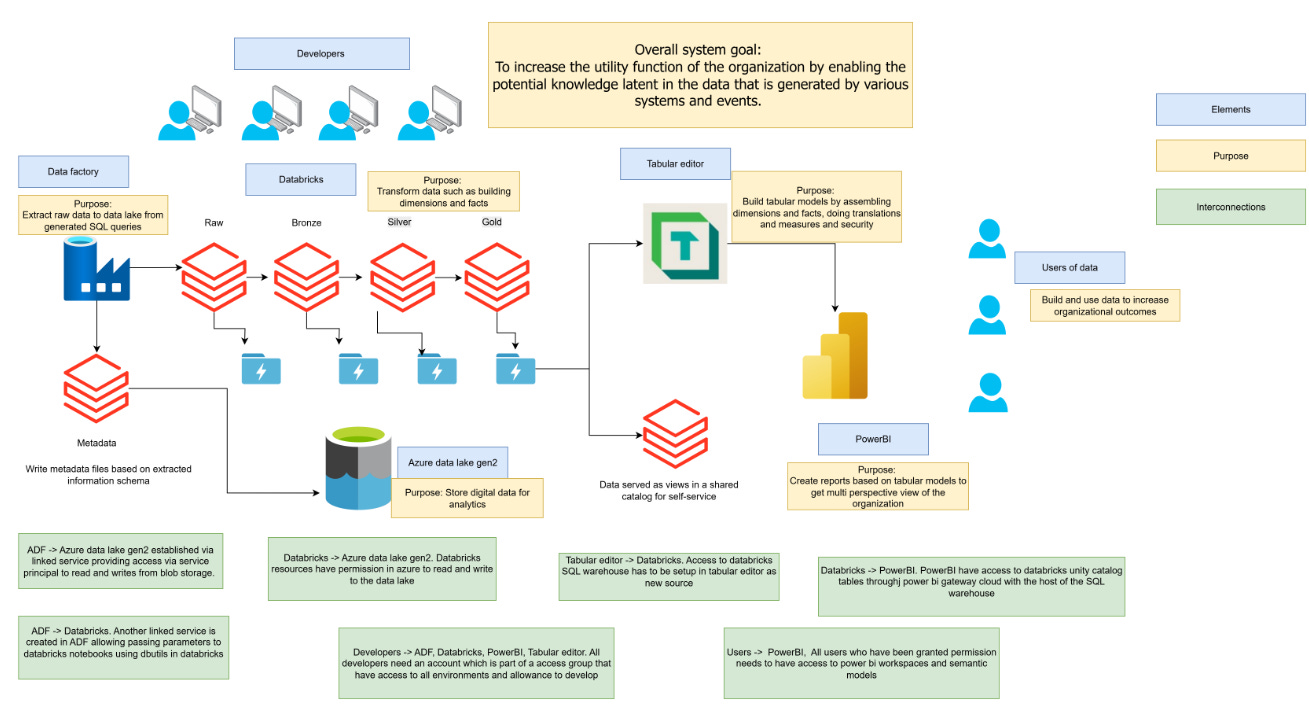
When I began to sketch a data platform from this perspective, some enlightening insights emerged.
1. Textbooks Focus Heavily on Tools
Most traditional treatments of data platforms emphasize the technological components: ingestion tools, storage solutions, transformation engines, and serving layers. But a data platform is more than its tools. It includes engineers, analysts, data stewards, and architects—human elements that interact with and shape the technological ones. My sketch (which I encourage readers to imagine or draw themselves) organizes these as blue boxes (elements), green lines (interconnections), and yellow nodes (purposes).
2. Elements Are Interchangeable
Many components in a data platform can be swapped out: Databricks for Snowflake, Azure Data Lake for AWS S3, one orchestration tool for another. Even developers can be replaced, assuming similar technical competence. Yet the system’s behavior often remains similar, suggesting that the resilience of the platform doesn’t rely solely on any single element.
3. Interconnections Are the Hardest to See
There is a great deal of interconnections that needs to be established for such a data system to function. The elements themselves are quite tangible and easy to spot but the interconnections are much less so. I remember when i started working professionally i was having quite a hard time understanding how everything was pieced together and that’s exactly the interconnections i was struggling with.
4. Purpose Can Drift
The purpose of the dataplatform overall is to provide information assets that can be put to productive use. If the system is designed right, the purpose should focus on quality and not quantity. Unfortunately the industrial mindset of highly visible production as a proxy for productivity to use Cal Newport’s words can easily make the purpose drift. The focus should be on long-term sustainable success with data and producing high quality solutions in an ethical manner. This is something that is useful to keep reminding oneself of when it seems that the system is falling back into the old ways or run away with the hype of new tools.
Building Systems That Work Well
Donella Meadows identifies several properties that well-functioning systems tend to exhibit. Here, I’ll reflect on three that struck me most deeply: resilience, self-organization, and hierarchy.
Resilience
“Resilience is the capacity of a system to absorb disturbance and still retain its basic function and structure.”
For a data platform, disturbances abound: cloud services fail, engineers leave, source systems change unexpectedly. I’ve seen these play out—and seen systems recover. What makes that possible?
Redundancy: Use of multiple data centers and failover mechanisms
Documentation & Knowledge Sharing: Mitigates the risk of staff turnover
Version Control & Infrastructure as Code: Helps restore broken deployments quickly
Resilience begins with identifying critical elements and designing buffers or backups. It includes not just infrastructure but the wellbeing of people: developers need psychological safety, nutrition, and support to function sustainably. We can generalize by working on
1) Be proactive in identifying areas that are important for the functioning of the system
2) Work on making them resilient and be proactive in seeking out the potential fluctuations
Self-Organization
“Where resilience restores a system to its prior state, self-organization pushes it into a new, evolved form.”
Self-organization is the ability of a system to learn and restructure itself. Think of the immune system gaining memory after an infection. It doesn't just return to normal—it becomes stronger.
Can data platforms learn?
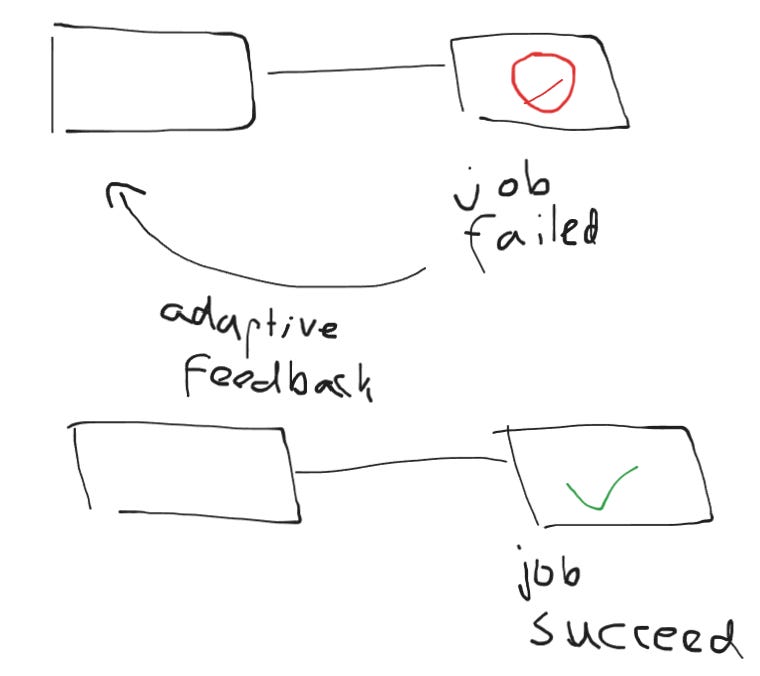
Imagine a pipeline that fails regularly. Could it detect failure patterns, adapt retries, or suggest structural changes?
Could engineers use performance logs and user feedback to redesign schema or storage models?
Could user queries influence caching or materialization strategies over time?
A self-organizing system doesn’t need to be fully autonomous, but it needs feedback channels and room for adaptation. Engineers who review performance metrics, ask peers hard questions, and explore external ideas play the role of self-organizing agents. Systems should support them—not stifle them.
Hierarchies
A well-designed system exhibits hierarchy: subsystems that work independently but contribute to the whole. In computing, this might look like transistors → logic gates → ALUs → CPUs → full machines.
Data platforms also exhibit hierarchy:
Code modules → Jobs → Pipelines → Products
Tables → Schemas → Databases → Platforms
Hierarchies allow modularity, reuse, and focus. We can improve one layer without needing to comprehend the entire system. Hierarchy is an architectural strategy to manage complexity.
Summing up
Data systems are more than a collection of tools. It's a system that comprise people with various expertise such as managing data, developing solutions both at the engineer level and analytical level. I believe we can benefit form taking a step back and think about designing data and analytical systems through the lens of systems thinking. which can be eye-opening in thinking about how to design well working systems that are resilient, self-organizing and modular. I hope this post gave you an interesting perspective on what our data systems look like when we take a step back and watch them through the lens of systems thinking. I invite readers to join the conversation. What does resilience look like in your platform? Where have you seen self-organization emerge—or be stifled? Let’s learn, reflect, and build better systems together.